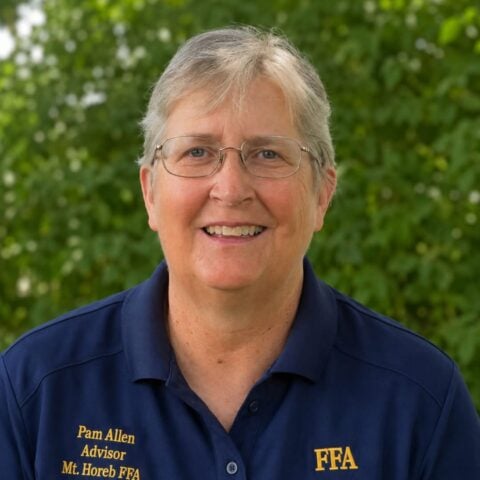
“Learning in my classroom is inherently hands-on. Students are not passive recipients of information—they are active problem-solvers, designers, and fabricators. I structure lessons to minimize lecture time and maximize meaningful engagement with tools, materials, and processes. Students learn how to safely operate welding equipment, interpret prints, measure and cut materials accurately, and evaluate weld integrity. Just as importantly, they learn persistence, communication, and accountability.”
For over three decades, Pam Allen has led the welding and metals program at Mount Horeb High School in Mount Horeb, Wisconsin. Her educational approach is deeply rooted in a lifelong background in agriculture, having owned and operated a cash grain and commercial beef farm in the Black Earth Valley since 1981, along with past leadership service as a USDA FSA State Chair. She holds a Bachelor of Science in Agricultural Education from the University of Wisconsin–Madison and is pursuing a Master of Science in Agricultural Education through the University of Wisconsin–River Falls. This practical agricultural and policy background directly informs her classroom, ensuring students master technical skills grounded in real-world application, accountability, and community contribution.
In the shop, students engage in hands-on coursework across Ag Mechanics, Ag Welding I and II, and advanced research in Gas Metal Arc Welding (GMAW) and Shielded Metal Arc Welding (SMAW). Emphasizing minimal lecture time, Allen believes the best way to learn welding is to pick up a torch, solve real problems, and create things that matter. She guides students through blueprint reading, precision measurement, safe equipment operation, and weld integrity evaluation. To navigate material costs, she redesigned projects to focus on design efficiency, craftsmanship, and structural testing with a bend tester.
Notes of Excellence
- Business & Industry Alignment: Madison College collaborates directly with the program, sending guest instructors into the classroom while providing dual credit pathway options across three welding courses to reduce post-secondary costs.
- Key Program Impact: Allen’s students are highly proficient and leave trained for post-secondary success through dual credit completion across advanced GMAW and SMAW coursework, preparing students directly for technical college, apprenticeships, or industry employment.
- Outstanding Student Project: Students collaborated with the Wisconsin Council of the Blind & Visually Impaired to design and weld an ADA-compliant, 45-degree angled metal display stand to hold an informational Braille and visual placard for their sensory garden, ensuring full accessibility for both standing visitors and wheelchair users.